Laser diffraction particle size analyzer for fast, accurate wet and dry particle size distribution measurement from nanometers to millimeters.
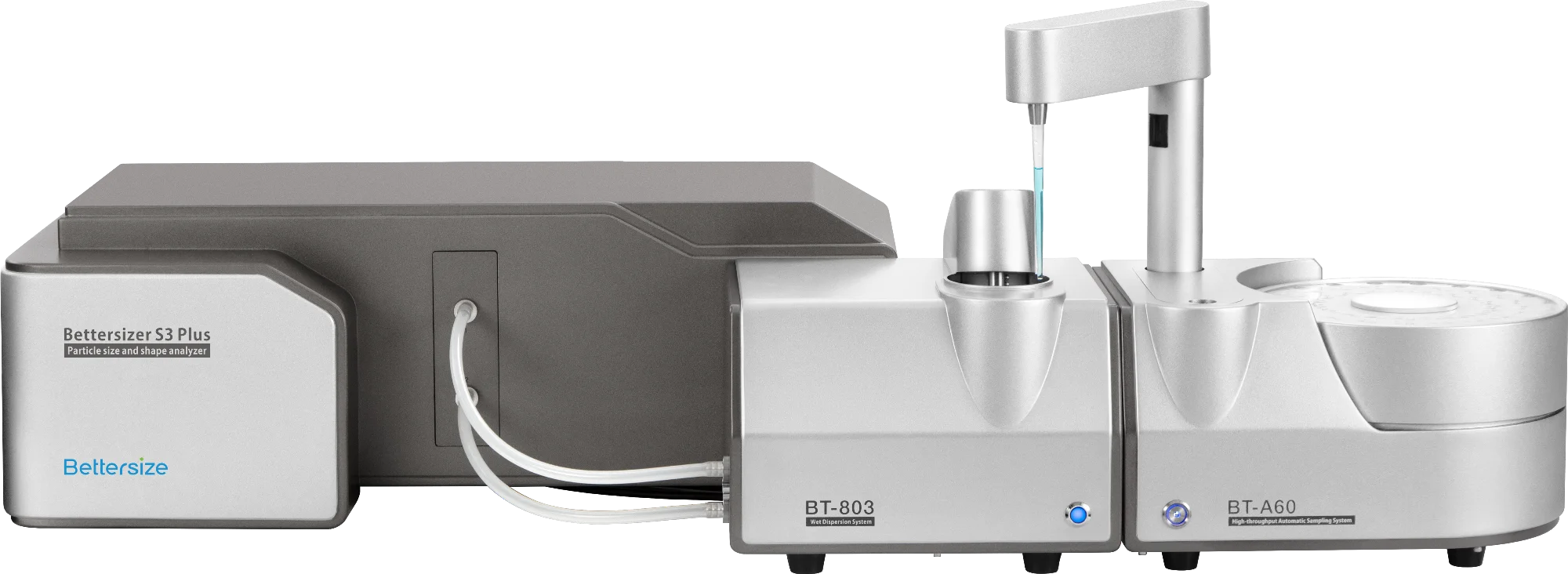


This laser diffraction particle size analyzer measures the angular distribution of scattered laser light from a particle ensemble to calculate the particle size distribution by volume. Fast, reproducible, and applicable to a wide size range from 10 nm to 3500 µm, covering dispersions, suspensions, emulsions, and dry powders.
Laser diffraction is the most widely used particle sizing technique in industry and research, providing rapid, reproducible, and operator-independent particle size distributions across a broad size range in a single measurement. When a particle ensemble is illuminated by a laser beam, each particle scatters light at angles inversely related to its size — large particles scatter at small angles, small particles at large angles.
An array of photodetectors positioned at discrete angles around the measurement cell captures the scattering intensity pattern, which is then mathematically inverted using Mie theory (for particles < ~10 µm) or Fraunhofer approximation (for larger particles) to yield the volume-based particle size distribution.
The system supports both wet dispersion — with a recirculating liquid cell for suspensions, slurries, and emulsions — and dry dispersion using a venturi-principle air disperser for free-flowing powders. Dual-wavelength laser and extended detector arrays provide enhanced sensitivity across the full size range.
| Method | Laser Diffraction (ISO 13320) |
| Size Range | 10 nm – 3500 µm |
| Measurement Time | < 30 seconds per sample |
| Laser | Red + blue (dual wavelength) |
| Detector Array | Wide-angle + backscatter detectors |
| Models | Mie theory, Fraunhofer approximation |
| Dispersion | Wet (recirculating) + dry (venturi) |
| Sample Amount | 5 mg – 5 g (dry) / < 1 g (wet) |
| Repeatability | < 0.5% RSD (d50) |
| Accuracy | < 1% of certified reference material |
| Software | Full automation, ISO report format |
| Standards | ISO 13320, USP <429>, Ph.Eur. 2.9.31 |
Our scientific instrument specialists are ready to help you find the best solution for your research needs.